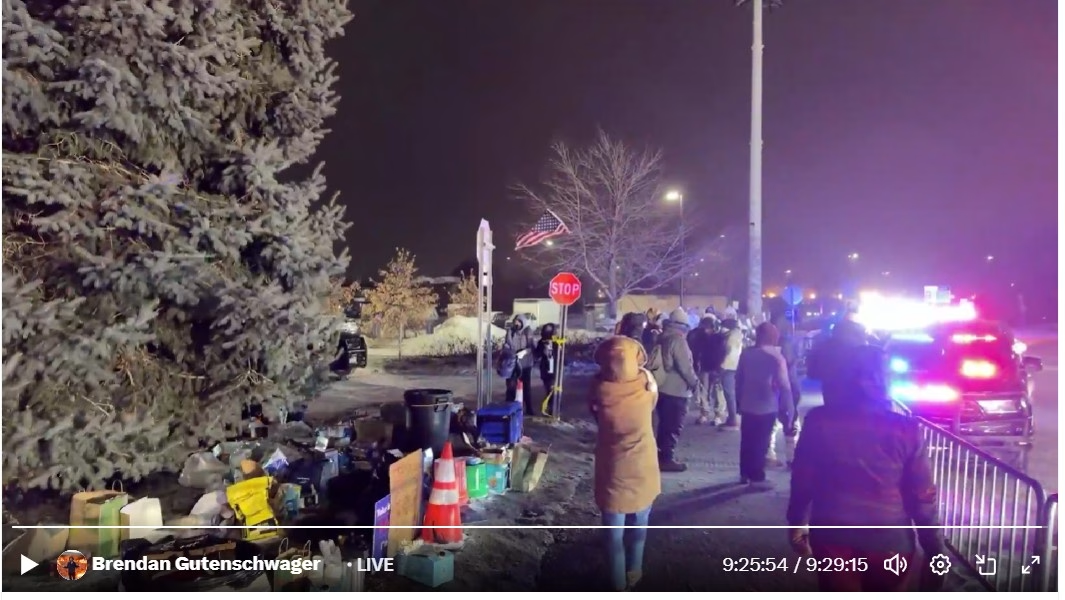
What unfolded in Minneapolis this weekend went far beyond loud protests. Multiple independent videos, eyewitness reports, and law enforcement accounts describe a city environment where people were openly hunted, harassed, and attacked over perceived political positions, while police units were allegedly ordered to stand down. From reporters being followed and assaulted, to churchgoers being screamed at, to businesses posting signs banning federal law enforcement, the situation increasingly resembled political street enforcement rather than constitutionally protected protest.
The most disturbing claim emerging since Saturday is that Minneapolis police officers on scene during the mob assault on Jake Lang were prepared to intervene but were ordered not to. If accurate, that decision did not just affect one man. It reshaped the entire operating environment of the city for the weekend.
What Minneapolis experienced was not simply protest. It was intimidation, selective enforcement, and the public testing of who controls the streets.
A Weekend That Looked Like a Modern Political Witch Hunt
One of Commander Greg Bovino’s posts described the weekend atmosphere as a “modern-day witch hunt,” documenting multiple instances of people roaming in groups, looking for ideological enemies rather than staging organized demonstrations. Videos circulating throughout Saturday and Sunday show individuals aggressively confronting passersby, surrounding people on sidewalks, blocking movement, and attempting to provoke physical altercations.
The recurring theme in many of these clips is not policy disagreement. It is pursuit.
People were not just shouting slogans. They were trailing targets, filming faces, demanding clothing be removed, and escalating encounters when someone refused to submit.
That is a critical distinction. Protest involves expression. What appeared repeatedly over the weekend was coercion.
“Take Off the Shirt”: Public Shaming in the Streets
One young man recorded that he was confronted and told to remove his shirt because it expressed support for ICE. The interaction was not framed as debate. It was framed as an order.
The crowd’s demand was simple: erase your viewpoint or face consequences.
That moment captured something larger than a single confrontation. It showed how political identity itself has become grounds for public discipline. Wearing the wrong words, even silently, was treated as provocation.
In healthy public squares, people argue. In unstable ones, people enforce.
Nick Sotor Incident Raises Alarming Questions About Safety
Journalist Nick Sotor released footage showing a group trailing him by vehicle. When he stopped, a woman took his camera. As he attempted to retrieve it, he was dragged by a moving car.
This was an act of pursuit followed by violence.
The targeting of reporters, regardless of ideology, signals a breakdown in public order. When journalists are followed, robbed, and physically endangered in broad daylight, the chilling effect is immediate. Documentation disappears. Accountability evaporates. The street belongs to whoever is most willing to use force.
Jake Lang Attack and the Alleged MPD Stand-Down Order
The most serious update involves the mob assault on Jake Lang on Saturday. According to a report submitted to media, a Minneapolis Police Department officer stated that MPD personnel were on scene, ready to intervene, and willing to extract victims who were being attacked by a large crowd.
They were allegedly ordered not to.
The officer said squad cars were directed to leave the area, which aligns with footage showing police vehicles departing while people were being beaten. The officer emphasized that morale inside the department is extremely low and deteriorating because officers are being prevented from performing the core mission they signed up for: protecting life.
If this account is accurate, it represents a major operational decision by leadership. It means violence was observed, capacity existed to stop it, and intervention was denied.
That changes everything.
First Amendment Rights and Selective Enforcement
The reminder circulating online this weekend was blunt: the First Amendment does not only protect speech you agree with.
Observers noted that MPD was initially issuing lawful orders to disperse. Then, abruptly, police presence vanished. Counter-protesters took control of the area. Harassment escalated. Assault followed.
This pattern, if confirmed, raises profound constitutional concerns. The state is not permitted to outsource enforcement to mobs. When law enforcement withdraws from volatile scenes while knowing violence is likely, it effectively grants permission to whoever is willing to dominate physically.
The right to protest does not include the right to assault, steal, threaten, or intimidate others into silence.
Businesses Posting Signs Banning Federal Law Enforcement
Another development adding to the weekend’s tension was the emergence of storefront signs explicitly banning federal law enforcement from entering.
In St. Paul, Gorditas El Durango posted a notice stating that any person or agency causing fear or insecurity to customers was not welcome. In Minneapolis, Up Coffee displayed a sign reading “federal agents not permitted on premises.”
Regardless of where one stands on immigration enforcement, these signs are not neutral. They communicate that federal officers are not protected participants in civil society, but intruders.
In an environment already charged with hostility, such declarations contribute to an atmosphere where targeting federal personnel, or those perceived to support them, becomes socially sanctioned.
Church Harassment and the Targeting of Worshippers
On Sunday, ICE’s official account shared information regarding an attack on a church. Additional videos showed people being yelled at while walking to worship services.
When political unrest spills into religious life, it signals a deeper unraveling. Churches are not protest sites. Worshippers walking into services are not political actors. When even that space becomes hostile territory, the conflict has moved beyond issue advocacy and into social fracture.
What Minneapolis Is Facing Now
Taken together, this weekend’s events paint a troubling picture.
People followed in cars. Journalists assaulted. Citizens ordered to remove clothing. A man beaten by a mob. Officers allegedly told to leave. Businesses declaring law enforcement unwelcome. Churches targeted. Worshippers harassed.
This is not a single protest story. It is a pattern of intimidation combined with institutional retreat.
Cities do not stabilize by ignoring political violence. They stabilize when the same rules apply to everyone, regardless of cause.
Minneapolis now faces serious questions. Who issued the stand-down order. Under what authority. And will leadership reaffirm that public streets are governed by law, not by whichever group shouts the loudest or swings first.
Because once the perception sets in that mobs, not institutions, decide who may walk freely, speak openly, or report honestly, the damage goes far beyond one weekend.
It becomes the new normal.