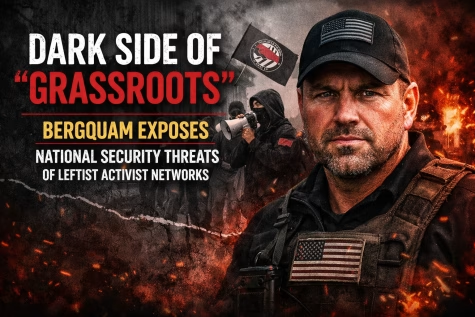
Focus: The Moment That Changed the Story “Standing With the Islands”
One of the most revealing moments in Ben Bergquam’s Baltimore footage this month happens before the confrontation turns physical.
As organizers begin explaining the purpose of the so-called “Ice Out” town hall inside the Enoch Pratt Free Library, a woman identified as part of the organizing group lays out what the meeting is about. What she describes goes well beyond a local discussion about immigration enforcement.
In the video, she connects the Baltimore gathering to ICE raids, U.S. actions abroad, Venezuela, Palestine, and economic issues. She then references joining calls with Caribbean countries and speaks about “standing with people in the islands.”
It is a brief remark, but it reframes the entire event.
Rather than presenting the meeting as a neighborhood forum focused on Baltimore-specific concerns, the organizer situates it inside a web of international causes and transnational activism. The language is not municipal. It is movement-based. It places a local library meeting inside a broader ideological struggle that reaches outside the continental United States.
In the same remarks, she explains that testimony from the event will be “recorded” and “submitted,” implying the gathering is part of a coordinated process, not a one-off community conversation.
This context is critical to understanding what unfolded next.
When Bergquam entered and began documenting the event, he was not treated like an attendee with opposing views. He was treated like an intrusion into an operation. The reaction was immediate and collective: people formed a physical barrier, blocked his camera, shouted him down, and ultimately forced him out.
The “islands” comment helps explain why.
The organizers themselves framed the meeting as one node in a wider resistance network. They tied immigration activism to foreign policy, to global grievances, and to international alignments. In that framework, unsanctioned documentation becomes a threat, not a disagreement.
Bergquam’s video captures that transition in real time. What begins as a scripted introduction about solidarity quickly collapses into crowd enforcement once a journalist is present who does not share the premises of the movement.
For observers reviewing the footage, the significance is not whether one agrees with the organizer’s politics. It is that her own words undermine the idea that this was simply grassroots community organizing. The meeting was presented as part of something larger, interconnected, and ongoing.
And moments later, that larger movement manifested not through speech, but through physical removal.
In that sense, the “standing with the islands” remark is more than an aside. It is the connective tissue between rhetoric and response. It shows how local activism is being framed by its own organizers as part of a broader ideological front — and why Bergquam’s presence, camera in hand, was met not with debate, but with force.
Over the past several weeks, the social media timeline of Real America’s Voice host and investigative reporter Ben Bergquam has documented what appears to be an escalating series of confrontations between a journalist and activist groups organizing against ICE and immigration enforcement. His recent posts, particularly surrounding a January 22 incident at a public library in Baltimore, show a progression from hostile encounters to physical removal from a public event, followed days later by evidence he had been placed on what is labeled a “Chicago Antifa Hostile Media” list.
Taken together, the videos and posts present a developing story about the increasingly volatile intersection of immigration activism, public institutions, and press freedom.
The Baltimore Library Incident
On January 22, Bergquam and journalist Josh Fulfer attended an event hosted by the People’s Power Assembly at the Enoch Pratt Free Library in Baltimore. The event was promoted as a public town hall declaring Baltimore a “Zone of Peace” against ICE.
According to video posted by Bergquam, the encounter deteriorated within minutes of his arrival. Footage shows individuals crowding around him, placing hands near or over his camera, shouting at him, and physically pressing him toward the exit. A library security guard is also seen yelling and assisting in removing him from the building.
“Did you authorize them to put hands on us?” Bergquam can be heard repeatedly asking as the crowd closes in.
The initial video was posted by Bergquam here:
https://x.com/BenBergquam/status/2014542764952666545?s=20
A second angle posted by Fulfer shows a large man stepping directly into Bergquam’s space, yelling at him and blocking his ability to record:
https://x.com/OreoExpress/status/2014566617603031198?s=20
Another clip shows a library security guard speaking aggressively toward Bergquam during the removal:
https://x.com/OreoExpress/status/2014571160281678254?s=20
Organizers ultimately canceled the meeting rather than continue with Bergquam present.
What Organizers Said Before the Removal
Before Bergquam was forced out, his footage captured remarks from an event organizer describing the scope of the gathering. She framed the Baltimore “Ice Out” town hall as part of a broader activist effort addressing ICE raids, U.S. actions abroad, Venezuela, Palestine, and economic issues, including food assistance programs.
She also referenced joining calls with Caribbean nations and standing with people “in the islands,” and stated that testimony gathered at the event would be submitted outside the local forum.
The framing, as heard in the video, positioned the Baltimore meeting not merely as a neighborhood discussion but as one node in a wider resistance network opposing policies associated with the Trump administration’s national security agenda.
It was shortly after these remarks that the confrontation escalated and Bergquam was removed.
Escalation Outside the Building
Follow-up footage posted later that evening shows Bergquam outside the library surrounded by a larger, agitated group. In the video, individuals can be seen yelling, advancing toward him, and continuing to block filming.
“Must see violation of our civil rights!” Bergquam wrote in the accompanying post.
That video is available here:
https://x.com/BenBergquam/status/2014732531472466351?s=20
The footage depicts a sustained confrontation rather than a brief disagreement, with multiple individuals participating and continuing after the formal ejection from the building.
Placement on a “Hostile Media” List
Days after the Baltimore incident, Bergquam posted what he said was evidence he had been added to a “Chicago Antifa Hostile Media” list.
The post included a screenshot of a document bearing that title and listing his name.
“That escalated quickly,” Bergquam wrote.
The post can be seen here:
https://x.com/BenBergquam/status/2014549050817667241?s=20
While the origins of the list are not independently verified, its appearance on Bergquam’s timeline reframed the Baltimore incident for many of his followers, suggesting that what happened in the library may not have been purely spontaneous, but part of a broader pattern of targeting journalists viewed as adversarial.
A Contrasting Narrative on the Same Timeline
Interspersed with the Baltimore footage are posts reflecting a sharply different side of Bergquam’s recent reporting.
In Washington, D.C., Bergquam shared an interview with Venezuelan opposition figure María Corina Machado, alongside retired Lt. Gen. Michael Flynn. In the video, Machado discusses the Venezuelan diaspora, narco-terrorism, and her support for President Trump’s actions against Nicolás Maduro.
“We want to reunite our families in a free country, in a secure country,” Machado said. “And millions will come back once we have a democratic Venezuela.”
That interview appears here:
https://x.com/BenBergquam/status/2014732531472466351?s=20
The contrast is stark: on one part of Bergquam’s timeline, dissidents advocating sovereignty, borders, and opposition to Marxist regimes; on another, domestic activist groups organizing “zones of peace” against ICE and forcibly removing a journalist from a public venue.
Why the Setting Matters
The Baltimore confrontation is drawing attention not only because of the aggression, but because of where it occurred.
The event was held in a public library and described by organizers as a town hall. Participants repeatedly referenced dialogue and testimony. Yet video shows that once Bergquam began recording, crowd members and security worked to exclude him physically from the space.
“This is a public forum, and you violated our First Amendment right,” Bergquam said as he was forced out.
No one on camera disputed that the building was public. The response focused instead on removing him.
Media observers note that this dynamic — political organizing inside public institutions combined with the exclusion of unsanctioned press — raises broader questions about access, transparency, and the boundaries between protest and suppression.
A Developing Story
Viewed individually, each video shows a confrontation. Viewed collectively, Bergquam’s recent posts outline a developing narrative:
organized local meetings explicitly tied to national and international resistance efforts;
crowds mobilizing to block filming;
security personnel participating in removing journalists;
and the appearance of formal labeling of reporters as “hostile media.”
Regardless of political alignment, the timeline documents a growing tension between activist movements and independent reporting in public spaces.
For Bergquam, the story is no longer limited to the border.
It is increasingly centered on who controls public forums, who decides which journalists are acceptable, and how dissenting coverage is being confronted on the ground.
Consider This: