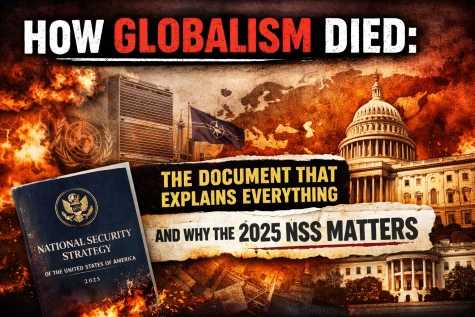
WHAT ARE WE TALKING ABOUT?
The 2025 National Security Strategy (NSS) transitions U.S. security policy to a narrowly defined, interest-based approach rooted in national sovereignty, economic and technological strength, military readiness, and a prioritized Western Hemisphere, with pragmatic engagement elsewhere based on core U.S. interests.
FULL PAPER: 2025 National Security Strategy
WHY IS THIS PAPER UNIQUE?
“The NSS presents a major realignment in U.S. strategic thinking under the Trump administration, prioritizing a narrowly defined U.S. national interest and a reshaped global role. It rejects post-Cold War doctrines of broad global leadership and moralistic promotion of liberal values, instead grounding security in economic strength, sovereignty, and pragmatic power projection,” According to White House documents.
According to the strategy’s introduction, previous U.S. policy suffered from an overbroad conception of national interest, an over-reliance on international institutions, an imbalance in global burdens, and weakened domestic economic foundations. The new NSS frames these as strategic miscalculations that diluted American power and security.
“Our elites badly miscalculated America’s willingness to shoulder forever global burdens to which the American people saw no connection to the national interest. They overestimated America’s ability to fund, simultaneously, a massive welfare regulatory-administrative state alongside a massive military, diplomatic, intelligence, and foreign aid complex.
They placed hugely misguided and destructive bets on globalism and so-called “free trade” that hollowed out the very middle class and industrial base on which American economic and military preeminence depend. They allowed allies and partners to offload the cost of their
defense onto the American people, and sometimes to suck us into conflicts and controversies central to their interests but peripheral or irrelevant to our own.
And they lashed American policy to a network of international institutions, some of which are driven by outright anti-Americanism and many by a transnationalism that explicitly seeks to dissolve individual state sovereignty. In sum, not only did our elites pursue a fundamentally undesirable and impossible goal, in doing so they
undermined the very means necessary to achieve that goal: the character of our nation upon which its power, wealth, and decency were built.”- PAGE ONE-INTRODUCTION
A core theme running through the document is that “economic security is national security”: economic strength underpins military power, deterrence, and geopolitical influence. This view integrates industrial capacity, energy production, and technological leadership directly into the national defense calculus.
Why Understanding Each Section Matters
• Introduction tells you why the strategy exists.
• Ends (II) define what America wants.
• Means (III) explain what the U.S. has.
• Strategy (IV) clarifies how it will act.
• Regions (V) translate strategy into actionable areas.
I genuinely think this National Security Strategy is one of the most clearly written and intellectually grounded government documents we’ve seen in a long time. It doesn’t talk in circles. It actually explains what strategy is, what America’s real interests are, and how power, economics, culture, and security fit together. That alone makes it worth printing out and keeping as a reference. It’s a framework. You can read it and actually understand what the administration is trying to build.
I also believe it’s crucial that everyone who considers themselves part of, or sympathetic to, the America First policy agenda takes this document seriously. There has been far too much palace intrigue, internal fighting, rumor-driven narratives, and circular arguments about foreign entanglements. This paper lays out, in black and white, what President Trump and his administration are actually doing and it represents a historic shift in how the United States defines its role in the world.
Instead of projecting motives or re-litigating old debates online, people should be studying this strategy. It gives context to decisions, budgets, alliances, and regional focus. If you want to understand where policy is going instead of reacting to headlines, this document is the roadmap.
This is part one of a series. We will go through the remaining sections.
Listen to what is being said about what Pete Hegseth calls “Trump Collary to the Monroe Doctrine”:
Some of our coverage of the Monroe Doctrine and policy strategy: