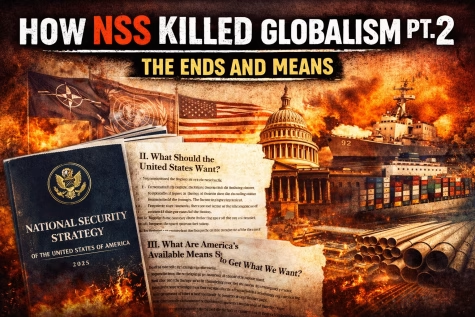
Why “Ends and Means” Are the Most Important Sections of the 2025 National Security Strategy
Resource for this article, Part One of the National Security Strategy:
Part II and Part III of the 2025 National Security Strategy are the intellectual core of the entire document. Part II defines what “success” actually means for the United States. Part III lays out what power, resources, and advantages America truly has to pursue that success. Together, they move the NSS out of the realm of slogans and into the realm of real strategy. If you understand these two sections, you understand the foundation every later priority, regional focus, and policy decision rests on.
What Are “Ends” and Why They Matter in National Strategy
In serious strategic thinking, “ends” means objectives. It answers the most important question any nation can ask: What are we trying to achieve?
Part II of the NSS is titled, in essence, “What Should the United States Want?” That framing is not rhetorical. It is deliberate. It forces clarity.
Rather than starting with threats, enemies, or alliances, this section starts with the nation itself. It defines U.S. interests before defining U.S. problems. That is a major departure from recent national security documents, which often opened with global challenges and then tried to fit American policy around them.
Here, the paper flips the model.
The strategy identifies success as:
• the continued survival of the United States as a sovereign republic
• the safety of its people and territory
• the protection of its economy and infrastructure
• the preservation of its independence and decision-making freedom
• the resilience of its industrial, technological, and cultural foundations
In other words, success is not “global leadership” in the abstract. It is national continuity, strength, and control of destiny.
This matters because every later debate about borders, trade, alliances, deployments, technology, energy, or diplomacy is now anchored to a defined national purpose. Policies are not justified because they are fashionable, humanitarian, or globally applauded. They are justified only if they advance these core ends.
This section also distinguishes between what the United States wants internally and what it wants in and from the world. That second part is critical. It outlines the international conditions America considers necessary for its own success: secure trade routes, stable neighboring regions, protected supply chains, technological leadership, and an international environment that does not allow hostile powers to threaten the U.S. homeland or its economic foundations.
By doing this, Part II establishes the measuring stick. Every future action can now be evaluated against one question: Does this advance these ends, or distract from them?
Why Defining Success Changes Everything
Most modern policy fights happen in a vacuum. People argue tactics without ever agreeing on objectives. The Ends section removes that fog.
When a nation clearly states what success looks like, several things happen:
• Trade policy stops being about abstract globalization and becomes about industrial survival.
• Border policy stops being a moral argument and becomes a sovereignty issue.
• Military posture stops being symbolic and becomes interest-driven.
• Foreign aid stops being charity and becomes leverage.
This is why Part II is so important. It is not a list of programs. It is a declaration of purpose.
And purpose is what disciplines power.
What “Means” Are and Why They Are Equally Critical
Part III answers the second unavoidable question of strategy: What do we actually have to work with?
This section inventories American power in a very old-school strategic way. It does not start with aspirations. It starts with assets.
It identifies the United States’ means as including:
• the world’s largest and most innovative economy
• industrial and energy capacity
• technological leadership potential
• military power and global reach
• geographic advantages
• alliance networks
• cultural and institutional influence
Importantly, this section treats economic, industrial, and technological strength not as background conditions, but as national security instruments. Factories, ports, energy production, research, logistics, and workforce capacity are framed as components of power alongside ships, aircraft, and intelligence agencies.
This is where the strategy most clearly breaks with late-Cold-War and post-Cold-War thinking. Power is not defined primarily by intervention capability. It is defined by productive capacity, resilience, and internal strength.
The Means section also emphasizes the reform and protection of those tools. It recognizes that power erodes. Economic advantage can be outsourced. Military superiority can be mismanaged. Technological leadership can be lost. Alliances can decay. Institutions can hollow out.
So this section is managerial. It asks: what do we truly possess, and what must be protected, rebuilt, or reoriented to support the defined ends?
Why Ends Without Means Are Fantasy Means Without Ends Are Chaos
The reason these two sections must be read together is simple: Ends without means are wishes. Means without ends are wasted power.
Part II alone would be ideology. Part III alone would be inventory.
Together, they become strategy.
When you connect them, several realities become clear:
• Economic policy becomes national defense policy.
• Industrial planning becomes geopolitical positioning.
• Technology investment becomes deterrence.
• Border control becomes strategic infrastructure.
• Energy independence becomes military readiness.
This connection explains why later sections of the NSS emphasize economic security, hemispheric stability, supply chains, and technological competition. Those priorities are not random. They flow directly from the ends-and-means framework.
Understanding these two sections allows readers to interpret everything else correctly. Regional priorities, alliance expectations, military posture, and diplomatic tone all derive from this foundation.
Why the Public Should Pay Attention to These Sections
Most people skip the theoretical parts of policy documents. That’s a mistake.
Part II and Part III tell you what future decisions will be justified by. They tell you what arguments will win inside government. They tell you what kinds of projects will be funded, what kinds will be cut, and what kinds of trade-offs leaders believe are acceptable.
If you only read headlines about deployments, trade disputes, or foreign summits, you see fragments. If you understand the Ends and Means, you see the architecture.
That is why these sections matter. They define success, name power, and quietly set the rules of the game for everything that follows.