Celebrating American Greatness With American Motor Racing
On January 30, 2026, Donald J. Trump signed an executive order that does something rare in modern public life. It unapologetically celebrates American excellence through sport. The Executive Order establishes the Freedom 250 Grand Prix in Washington, D.C., an INDYCAR street race timed to America’s 250th anniversary. This is not symbolic fluff. It is a serious cultural statement about who we are and what we value.
For more than a century, INDYCAR has represented speed, courage, innovation, and mechanical ingenuity. At a moment when American sports culture often feels fragmented or commercialized beyond recognition, this order recognizes racing as a living national institution.
INDYCAR as a National Institution
The executive order begins by grounding INDYCAR in history. It points to legends like A.J. Foyt and Mario Andretti, names that still resonate because they were built on consistency and risk, not branding campaigns. INDYCAR cars exceed 200 miles per hour. There is no hiding, no coasting, no safety net created by gimmicks. Drivers and teams earn every inch.
The order also highlights the Indianapolis 500, held at the Indianapolis Motor Speedway. With hundreds of thousands of fans in attendance, it remains the largest single-day sporting event in the world. That scale matters. It speaks to a deep, multigenerational loyalty that few modern sports can claim.
The Freedom 250 and the Meaning of 250 Years
The Freedom 250 Grand Prix is not just another race. It is designed as a centerpiece for the semiquincentennial celebration of American independence. By routing an INDYCAR street course through Washington, D.C., near national monuments, the race fuses speed with civic memory.
This matters because America’s 250th anniversary should not be reduced to speeches and fireworks alone. It should reflect motion, ambition, and forward momentum. Racing through the capital does exactly that. It reminds the world that America is not a museum. It is a nation still moving fast, still competing, still inventing.
Government, Infrastructure, and Innovation
Sections two and three of the order are unusually practical. The Secretaries of the Interior and Transportation are tasked with designating a viable race route within fourteen days. Permits and approvals are to be expedited. Roads and bridges must be race-capable. Aerial photography, including unmanned aircraft systems, is encouraged under proper authorization.
This is not bureaucratic excess. It is an acknowledgment that innovation requires cooperation. INDYCAR has always been a testing ground for advances in safety, aerodynamics, and engineering. When government facilitates rather than obstructs, the benefits ripple outward to manufacturing, logistics, and media.
Team Owners as the American Story
The reaction from the paddock underscores why this matters. Team owner Ricardo Juncos publicly celebrated the announcement, and his story captures the American promise better than any slogan. Juncos moved to the United States in 2002 and built his operation from the ground up. His team famously beat Fernando Alonso for a spot in the 2019 Indy 500, a reminder that pedigree does not guarantee success.
Today, Juncos Hollinger Racing operates out of a state-of-the-art facility in Indiana, co-owned with Brad Hollinger, a former Williams Formula One shareholder. This is American racing culture at its best. Immigrants and investors, engineers and drivers, all judged by performance.
Drivers Who Carry the Tradition
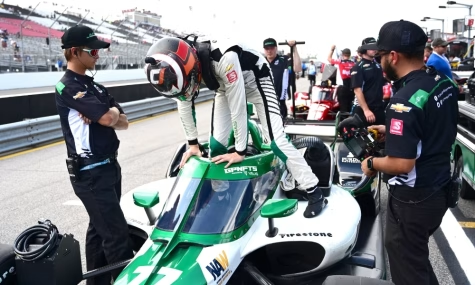
The same ethos is visible on track. Santino Ferrucci, currently driving for AJ Foyt Racing, represents the modern INDYCAR competitor. Fierce, focused, and unapologetically competitive, Ferrucci embodies a sport where effort is visible and consequences are real. There is no hiding behind simulations or excuses at 230 miles per hour.
Why This Matters Now
American sports culture has always taught lessons that go beyond entertainment. INDYCAR rewards teamwork, precision, patience, and grit. Wins are rarely flukes. They are built over months and years and decades of preparation. That is a message worth elevating in 2026.
The Freedom 250 is nostalgia and it is a declaration that American excellence still thrives where risk meets responsibility. By placing INDYCAR at the heart of the 250th anniversary, the executive order reframes patriotism as achievement rather than abstraction.
Racing as Civic Culture
This executive order is news because it connects policy, infrastructure, and culture without apology. It understands that American greatness is not only written in documents. It is built in garages, tested on track, and proven under pressure.
As the world watches cars race past monuments in Washington, the message will be unmistakable. America celebrates its history by moving forward at full speed.