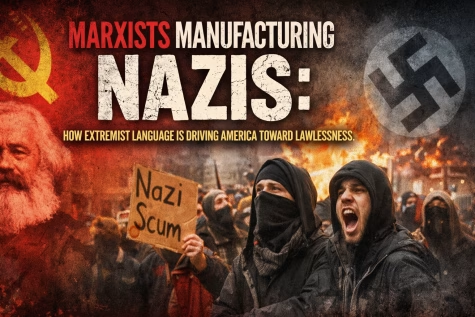
How Viral Investigations Reveal a Broader Cultural Crisis. Analyzing Community Organizing, Alinsky’s Influence, and the Normalization of Extremist Labels
An investigative thread circulating widely on social media, shared by attorney Harmeet Dhillon Assistant Attorney General for Civil Rights at the U.S. Department of Justice, has struck a nerve in national debates over protest culture, political rhetoric, and law enforcement in America.
Resources for this article:
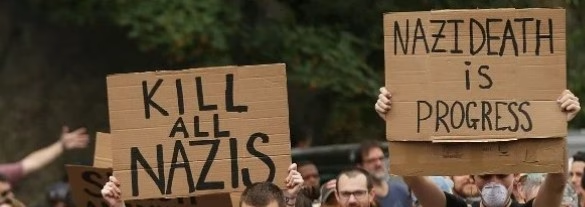
The thread compiled by an independent researcher (linked here: https://x.com/threadreaderapp/status/2015537309496541591?s=20 and https://x.com/Tyler2ONeil/status/2015520247898427874?s=20) examines a recent Minneapolis protest in which demonstrators hurled the epithet “Nazis” at federal agents, and a widely-viewed video captures anti-ICE protesters shouting the same (see: https://www.youtube.com/watch?v=CvKG1MZWrtw).
What this episode reveals, and what the author of the investigation argues, is a deeper pattern in which the use of extremist labels has become detached from their actual meaning, contributing to social fragmentation, lawlessness, and political polarization.
Minneapolis and the Viral Video: A Flashpoint for National Debate
In late January 2026, federal immigration agents — part of an operation dubbed Operation Metro Surge — shot and killed a Minneapolis man identified as Alex Pretti, a 37-year-old ICU nurse and U.S. citizen. This marked the third such fatal encounter between federal agents and civilians in a short span, following the earlier death of Renee Good, also shot by an ICE agent.
Pretti’s death has ignited nationwide protests and intense media scrutiny. Official accounts from federal authorities claim the agents fired in self-defense; video footage obtained by independent journalists and citizen documentarians appears to contradict this, showing Pretti holding a phone at the time of the encounter rather than a weapon.
For many observers, this incident has become emblematic of broader disputes over immigration enforcement, federal power, and civil liberties and has fueled rhetoric that paints federal agents as “Nazis” or akin to authoritarian stormtroopers.
But Community Organizers have been institutionalizing the use of the label on everyone in politics from reporters, to social media posters, to activists, to candidates, to lawmakers, since 2016 at least. See this discussion at Redit in the overuse of the word, which was already on people’s radar.
When “Nazi” Becomes Everyday Political Slang
The viral investigation highlighted by Dhillon suggests the frequent use of “Nazi” as a catch-all insult has shifted from being a historical reference to a daily weapon in political public discourse. This mirrors broader social trends wherein labels of extremism are applied with increasing looseness. Adversaries are not described as political opponents; they are Nazis, fascists, or terrorists, regardless of context or evidence.
Consider this:
This phenomenon has real consequences:
- Devaluing historical meaning: The term “Nazi” once described a specific genocidal regime and ideology; repeated misuse in everyday political fights can numb public understanding of what actual fascism entails.
- Escalating conflict: Labeling law enforcement or political opponents as Nazis or fascists lowers the threshold for outrage and increases the likelihood of confrontational behavior at demonstrations.
- Undermining civil discourse: When rhetoric default-positions opponents as existential threats rather than policy adversaries, the space for compromise and democratic negotiation shrinks.
The investigation’s author provides screenshots and annotations from the protest video to show this pattern in action — asserting that such incendiary rhetoric lays groundwork for misperception and social disorder.
Saul Alinsky, Community Organizing, and the Current Climate
To understand how this communicative shift occurred, many analysts point to Saul Alinsky’s Rules for Radicals a manual on community organizing first published in 1971 that has been widely studied and adapted across political movements. Alinsky’s approach emphasized:
- Targeting power structures strategically
- Mobilizing everyday people through issue framing
- Using provocative tactics to shift narratives and build leverage
Critics on both the right and left have interpreted Rules for Radicals differently: some see it as community empowerment, others portray it as a blueprint for social disruption. What cannot be denied is Alinsky’s influence on modern grassroots organizing particularly in movements that frame opponents as existential threats to justice or freedom.
The theory of Alinskyite organizing posits that raising the emotional temperature fundamentally changes public perceptions and forces institutions to respond. But when this reframing hinges on labeling mainstream actors like federal law enforcement as Nazis or fascists, the line between protest and provocation can blur.
Linking Narrative to Real-World Lawlessness
In Minneapolis and elsewhere, the rhetoric has become entangled with real confrontation. Nationally, protests over the Minneapolis shootings have spanned multiple cities, with demonstrators demanding accountability, transparency, and changes to federal policing tactics.
This landscape — where protesters feel empowered to loudly equate federal agents with historical tyrants — reflects a broader cultural fracture. For many Americans, such rhetoric feels justified by perceived injustices. For others, it represents an erosion of reasoned debate and a drift toward labeling innocent people as malevolent actors.
This contributes to:
- Distrust in institutions
- Heightened tensions at demonstrations
- A sense that political opponents aren’t just wrong they’re evil
When rhetoric outpaces facts, civil society pays the price.
The Urgent Need for Meaningful Dialogue
The investigation shared by Dhillon and originally produced by an independent researcher has resonated because it captures more than one protest’s video — it encapsulates a broader sociopolitical shift.
Readers should explore the full investigation here:
https://x.com/threadreaderapp/status/2015537309496541591?s=20
https://x.com/Tyler2ONeil/status/2015520247898427874?s=20
Whatever one’s perspective on federal policy, community organizing, or protest tactics, reclaiming precise language and historical context is crucial to maintaining democratic norms. Equating political opponents with Nazis or fascists may score viral points, but it also risks diminishing public understanding of genuine atrocities and undermining the possibility of productive political engagement.
Language matters and in an era of hyper-charged rhetoric, the distinction between naming real threats and weaponizing labels for effect is central to restoring civic trust and reducing unnecessary conflict.
Our recent coverage on the tactics of the Marxist Left:
This is what the left is fighting: