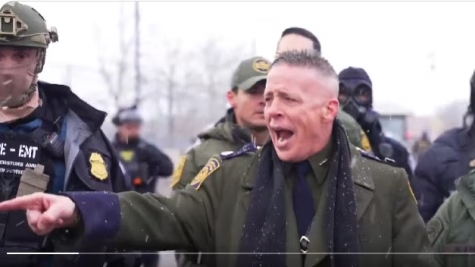
FOCUS: Federal immigration officials are no longer framing the events in Minneapolis as routine protest activity. They are talking about ramming, mob assaults, and an operational environment they say is becoming openly hostile to federal law enforcement. In a wide-ranging interview with WCCO’s Esme Murphy, Border Patrol Commander Gregory Bovino described a large-scale Title 8 immigration mission underway in the Twin Cities, repeatedly stressing that thousands of federal officers are on the ground, violence is increasing, and agents will continue enforcement despite growing unrest.
Greg Bovino on the streets in Minneapolis:
“We are here conducting a Title 8 immigration mission. That’s why we’re here. We’re going to conduct that Title 8 mission. If they are criminal aliens or illegal aliens, they should probably be very scared, because we are here,” Bovino said on Saturday.
Watch the full video:
Resources for this article:
“Title 8”: Title 8 immigration refers to the primary body of U.S. federal law (U.S.C. Title 8) governing “Aliens and Nationality,” encompassing immigration, naturalization, and deportation processes, which allow for legal entry, asylum claims, and removal, often leading to severe penalties like re-entry bans for unauthorized crossings after Title 42 ended, enforcing established immigration codes with potential criminal consequences.
His message was direct. Lawful residents have nothing to fear. Criminals and illegal aliens should. And agitators, he warned, are driving the city toward far more serious territory.
Those warnings gained urgency Saturday afternoon, when a downtown rally attempt ended with activist Jake Lang and a small group of supporters being assaulted by violent mobs. Video circulating online shows Lang being struck in the head, pulled from a ledge, and chased as he tried to reach a vehicle.
As the chaos spread, the crowd turned on other men who were seen running away. Two reportedly suffered head injuries while trying to defend themselves. Incidents like this shift the entire conversation around public safety. What began as demonstrations connected to immigration enforcement is now showing repeated signs of coordinated hostility and physical harm.
When people are being hunted through public streets and beaten, it forces authorities to reassess whether normal crowd control measures are still enough. That is the type of escalation federal agencies monitor closely when determining whether civil order is deteriorating.
What ICE Says Is Happening on the Ground
Commander Bovino made clear that this is not a symbolic deployment. He repeatedly emphasized that this is a Title 8 immigration enforcement mission, referring to the section of U.S. law that governs immigration arrests and removals.
“We are here conducting a Title 8 immigration mission,” Bovino said. “That’s why we’re here. We’re going to conduct that Title 8 mission.”
He pushed back strongly on fear being spread throughout the community.
“Those individuals that are worried, if they are United States citizens or legal permanent residents or have some type of legal status to be or remain here in the United States, there’s no reason to be scared,” he said. “However, if they are a criminal alien or an illegal alien, then they should probably be very scared because we are here.”
Bovino urged illegal immigrants to use the CBP Home app to self report and begin legal processes. “We’re giving them a fantastic opportunity to do that,” he said.
Reports of Rammings and Growing Violence
What stood out most in the interview was Bovino’s description of how often agents are encountering violence.
“We’ve already had vehicle rammings today on the ground here in Minneapolis,” he said. “Well over twenty, probably approaching thirty by the end of today.”
He described a situation where a suspect used a vehicle repeatedly.
“I believe that was a multiple ramming situation where an individual not only rammed our vehicles once, but decided to do it multiple times,” Bovino said. “It’s not a smart idea to ram a federal agent. Once much less multiple times.”
He also addressed the fatal shooting of Renee Good, saying the agent was placed into a rapidly evolving and dangerous environment.
“That agent had no clue that that was going to happen, but he was put into that violent situation and reacted when a four thousand pound missile came right at him,” Bovino said. “These situations are three hundred sixty degree situations. Crowds forming. Known violence.”
Why Agents Were Recording
The commander defended federal agents recording operations after criticism that an ICE agent was filming instead of wearing a body camera.
“Videotaping is very important,” Bovino said. “That video tells a story.”
He pointed out the contradiction officers face.
“When we don’t have a video, some of these same individuals say, well gosh there’s no video so that must not have happened,” he said. “So let’s not put these agents and police officers in a catch twenty two.”
He added that body camera policies differ by mission.
“If you’re undercover and you’ve got a body camera sticking right out, you’re not undercover anymore,” Bovino said.
A Warning: Becareful Who You Listen To
One of the strongest sections of the interview came when Bovino addressed what he called dangerous rhetoric from political leaders and activist figures.
“I have to say that Mayor Frey and Governor Walz, that heated rhetoric causes that,” he said, referring to the violence being directed at federal agents.
He went further, warning residents to stop letting political messaging drive them into confrontation.
“Don’t fall victim to whether it’s a shady immigration lawyer or a community activist that has an agenda,” Bovino said. “A lot of these individuals don’t care about the constituents or the individuals. The people here on the streets of Minneapolis.”
He added that some residents are being emotionally steered into dangerous situations.
“Some of these weaker minded people fall victim to what these individuals say,” he said.
His message was simple. Think for yourself. Violence against federal officers has never been acceptable.
Is Minneapolis Moving Toward Insurrection Act Territory
The Insurrection Act is not triggered by angry speeches or even large protests. It becomes relevant when sustained violence interferes with the ability of authorities to enforce the law.
Bovino hinted at that threshold without naming it directly.
“If I’m having problems conducting that Title 8 mission, then we’ll deal with that accordingly,” he said.
He also stated that he is reporting conditions directly to Homeland Security leadership and President Trump.
“If the situation is even worse, I’m reporting what I need to deal with the situation,” he said.
Historically, when federal officers are being rammed, chased, and assaulted while attempting to carry out lawful operations, the conversation inside government shifts rapidly from crowd management to constitutional authority.
Ending on a Different Note
Despite the severity of his warnings, Bovino closed his interview with a message aimed at the broader public.
“For those ninety to ninety five percent of Minnesotans, we respect you and we love you,” he said. “We respect you and we love you.”
That closing line matters. It shows federal leadership views this mission not as a confrontation with a city, but as enforcement aimed at criminals while recognizing that most residents want safe streets and functioning law enforcement.