Why Aaron Reitz Says This Fight Starts With the Attorney General
Republican voters in Texas will see Proposition 10 on the March primary ballot. It asks whether Texas should prohibit the application of Sharia law. On Thursday’s Steve Bannon’s WarRoom, Bannon and national security analyst Frank Gaffney warned that Texas has become ground zero in a long-term strategy they describe as civilizational infiltration, what Bannon called coming in on “cat’s paws,” quietly, indirectly, and through institutions.
At the center of this major fight is the race for Texas Attorney General. Aaron Reitz, a Republican candidate endorsed by current Attorney General Ken Paxton, says he is the only candidate with an actual legal record of fighting what he calls Islamic ideological expansion. Reitz argues that Proposition 10 is only the signal. The real enforcement battle, he says, will be carried out by the next attorney general.
Thursday WarRoom clip:
What Is Proposition 10 in the Texas Republican Primary?
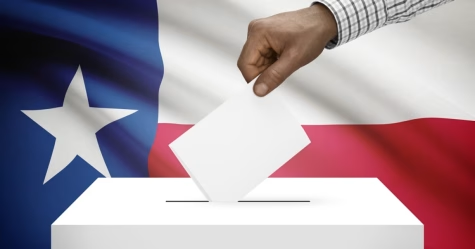
Proposition 10 is a non-binding Republican primary ballot proposition. It asks GOP voters whether Texas should prohibit the use of Sharia law in the state.
While it does not itself create law, it is designed to measure voter support and send a mandate to lawmakers and statewide officials. A strong “yes” vote would signal that Republican voters want the legislature and the attorney general’s office to act more aggressively to block foreign legal systems from being recognized or enforced in Texas.
On WarRoom, Frank Gaffney framed it as a defining civilizational question. “For Republican voters in the state of Texas, overwhelmingly, to say Texas should prohibit Sharia law, and that’s where this battle can be joined and fought,” he said.
Bannon’s Warning: “Cat’s Paws” and the Second Alamo
Steve Bannon described what he sees as a long-term strategy operating quietly through nonprofits, government programs, and local institutions. He referred to it as coming in on “cat’s paws,” a phrase meaning indirect action, using intermediaries and systems rather than open confrontation.
Bannon and Gaffney discussed recent investigations into alleged fraud involving Islamic-linked organizations in Minnesota as a warning for Texas. Their argument was not about one case or one organization, but about what they see as a broader pattern: embedding within social services, education, finance, and immigration systems.
“This is not coming in with armies,” Bannon said in substance. “It’s coming in subtly.”
Bannon repeatedly called Texas “the second Alamo,” arguing that if Texas draws a firm legal line, it becomes a national firewall. If it does not, he warned, the consequences spread far beyond the state.
Why Proposition 10 Puts the Attorney General Race at the Center
Both Bannon and Gaffney emphasized that even if Proposition 10 passes overwhelmingly, it will mean little without enforcement. That enforcement power sits largely with the Texas Attorney General.
The attorney general controls civil enforcement, consumer fraud actions, nonprofit oversight, state litigation, and the use of statutes tied to public safety, business practices, and foreign influence. In short, the office has the legal machinery to investigate, sue, block, and dismantle networks operating in Texas.
That is why Bannon pivoted quickly from Proposition 10 to the attorney general’s race, introducing Aaron Reitz as the candidate he believes is positioned to act on it.
Aaron Reitz: “The Only One With a Record”
Aaron Reitz told WarRoom that while many candidates talk about the issue, he is “the only one in this race with an actual record leading legal troops into legal combat.”
Reitz argued that Islamic ideological expansion has been building for decades and accelerated through immigration policy, federal funding streams, and political reluctance to confront it. He described Texas as “ground zero.”
He pointed to current actions already underway, including lawsuits involving Islamic-linked developments and Governor Greg Abbott’s declaration identifying certain organizations as transnational criminal or terrorist entities. Reitz said those declarations trigger entire sections of Texas law that an attorney general can use, from property codes to consumer protection statutes to criminal enforcement tools.
“What Texans need,” Reitz said, “is someone who knows how to use those tools.”
His core claim is that he is not running on promises, but on past legal work inside the Justice Department and alongside Texas leadership. “I’m the only one who’s actually done it,” he told Bannon.
Ken Paxton’s Endorsement and Why It Matters
Ken Paxton’s endorsement has become central to Reitz’s campaign. Paxton is one of the most aggressive attorneys general in the country in using the office to pursue ideological and constitutional battles, from border enforcement to federal overreach.
Reitz said Paxton endorsed him because of his legal record and because he believes the next phase of the fight requires someone who can immediately deploy the office’s power.
In an endorsement video referenced on the program, Paxton said Reitz would be “the greatest attorney general Texas has ever seen.” Reitz also noted that President Trump previously called him “a true MAGA attorney and a warrior for the Constitution.”
The campaign is clearly positioning Reitz not as a legislator or administrator, but as a legal combatant.
Why Reitz Ties Proposition 10 to Enforcement
Reitz strongly encouraged Republican voters to vote yes on Proposition 10, but he framed it as only the beginning.
“Once we signal that Texans want a real law ban,” he said, “it’s going to have to be guys like me who take that mandate and go to war up and down the justice system.”
In other words, Proposition 10 creates political authority. The attorney general determines whether that authority becomes lawsuits, investigations, asset seizures, corporate actions, or regulatory crackdowns.
From Reitz’s perspective, the ballot proposition is the match. The attorney general is the fuel.
March Primary: A Ballot Question and a Power Question
Texas Republican voters are not only weighing in on Proposition 10. They are deciding who will hold one of the most powerful legal offices in the country.
Bannon framed it bluntly: Texas sets the direction. The direction determines the nation.
For voters who see Sharia law and Islamic political ideology as a serious threat, Proposition 10 offers a way to register that view. The attorney general race determines whether anyone will act on it.
Aaron Reitz is running on the claim that he is the only candidate prepared to do more than talk.