Cam Higby’s Minneapolis Exposé Reveals a Coordinated Resistance Network Targeting Federal Authority
Cam Higby’s recent undercover reporting out of Minneapolis paints a picture that goes far beyond spontaneous protest or local activism. Through a series of posts documenting infiltration of encrypted activist chats, surveillance behavior, and operational coordination, Higby has assembled what amounts to a bird’s-eye view of a structured resistance ecosystem. His material suggests organized tracking of targets, layered security protocols, coded command structures, and potential information-sharing pipelines that may intersect with public institutions.
And his work has been detected by the signal participants:
Seen in the context of John Solomon’s recent investigation into the “business plan behind the chaos,” and President Trump’s statement alleging a massive cover-up in Minnesota, Higby’s reporting adds a ground-level dimension to a broader national debate: whether what is unfolding in cities like Minneapolis represents protest culture or the operational footprint of a coordinated political resistance network.
Consider this:
Cam Higby’s Investigation: A Look Inside the Network
Higby, an independent investigative reporter, has spent recent weeks documenting what he describes as organized resistance activity in Minneapolis. His posts focus not on rallies, but on logistics: communications infrastructure, counter-surveillance, internal administration, and target monitoring.
In one of the most striking posts, Higby describes being followed by what he characterized as a convoy.
“Protestors followed us for over an hour. It was a convoy of several people, specifically a grey Honda. We went in a full circle of right turns and they continued tailing us. This happens every time we enter South Minneapolis.”
https://x.com/camhigby/status/2014815758086271450?s=20
The allegation is not that demonstrators shouted protest slogans, but that organized teams tracked movement patterns and maintained contact over extended periods.
That distinction matters. Surveillance is not a protest tactic. It is an operational one.
“Minneapolis Signal Infiltrated”: Inside the Communications Structure
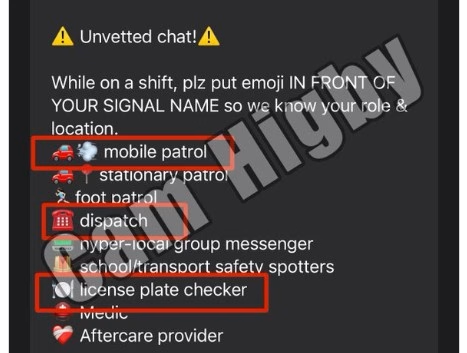
Higby’s central thread, titled “MINNEAPOLIS SIGNAL INFILTRATED,” outlines what he says are internal activist chat environments operating on encrypted messaging platforms.
He posted screenshots of administrative lists and group structures, writing:
“Here is an admin list for several chats. These generally consist of code names.”
https://x.com/camhigby/status/2015094493985345728?s=20
According to Higby, these chats are not static message boards. They are actively curated environments with controlled access, internal leadership layers, and security measures.
In a follow-up, he added:
“The coordinators frequently delete messages to cover their tracks. This is another layer of security on top of the daily chat refreshes.”
https://x.com/camhigby/status/2015094486305497294?s=20
That description points to operational discipline: ephemeral communications, administrator hierarchies, and ongoing attempts to minimize digital footprints.
Those are not characteristics of casual community organizing. They are hallmarks of structured networks.
Allegations of Information Pipelines and Law Enforcement Data
One of the most serious developments did not come from Higby himself, but from analysts reviewing his material.
A response to his thread highlighted what the commenter described as a potential CJIS (Criminal Justice Information Services) violation.
“Those chat threads contain sharing of certain sensitive information, i.e. license plate ID’s, that normies… would not have access to… The logs presented suggest that members of local Minneapolis police are helping them, by looking up that information.”
https://x.com/_emergent_/status/2015160467782517058?s=20
If accurate, that allegation would suggest the possibility of unauthorized access to protected law-enforcement databases to support activist tracking operations.
The commenter added:
“CJIS is allowed only for law enforcement purposes… You are not allowed to use it for private or personal use, or political activism.”
While these claims have not been independently verified, their presence in the analysis of Higby’s infiltrated chats underscores why his reporting is drawing attention. The material does not describe protests. It describes intelligence-style activity.
Training, Tools, and Organizational Linkages
Additional posts connected the Minneapolis organizing infrastructure to external activist groups and digital platforms.
One analyst highlighted that the SALUTE app — reportedly referenced in activist ecosystems — links to NYSYLC, an undocumented youth-led organization based in New York.
“The group and their funders should be investigated for inciting violence and impeding law enforcement activities.”
https://x.com/listen_2learn/status/2015123152460779775?s=20
Whether or not those allegations are substantiated, the broader implication remains: Minneapolis activism, as documented by Higby, does not appear siloed. It appears networked.
Across his threads, Higby documents:
• administrator-run encrypted chats
• daily message refresh protocols
• deletion practices to avoid digital retention
• coded identities
• coordinated tracking behavior
• and organized counter-surveillance
Those elements collectively resemble operational planning, not ad-hoc activism.
Why John Solomon’s Reporting Matters Here
The significance of Higby’s findings expands when placed alongside John Solomon’s recent reporting on what he described as the “business plan behind the Dem chaos.”
In that report, Solomon outlined financial pipelines, organizational structures, and institutional relationships that he says underpin nationwide protest movements.
Solomon wrote that subpoenas may be forthcoming as investigators examine whether political chaos is being professionally engineered rather than organically generated, which came to pass.
That report can be read here:
https://frontlineamerica.com/the-business-plan-behind-the-dem-chaos-solomon-says-subpoenas-may-be-next/
Higby’s work supplies what Solomon’s piece suggests exists: operational texture. His posts show how such a system might function on the ground through encrypted coordination, layered leadership, and field-level activity.
President Trump’s Minnesota Statement and the State-Level Lens
On January 24, President Trump directly addressed Minnesota in a Truth Social post:
“AMONG OTHER THINGS, THIS IS A ‘COVER UP’ FOR THE BILLIONS OF DOLLARS THAT HAVE BEEN STOLEN FROM THE ONCE GREAT STATE (BUT SOON TO BE GREAT AGAIN!) OF MINNESOTA!”
The statement framed unrest and institutional dysfunction in Minnesota as potentially serving to obscure deeper financial and political issues.
Higby’s reporting, focused on Minneapolis, adds an enforcement and organizational layer to that claim. It shifts attention from protests themselves to the infrastructure behind them.
Why Understanding This Matters
The importance of Higby’s investigation lies not in any single clip, but in the composite picture.
His timeline does not document signs, chants, or marches.
It documents administration, surveillance, coordination, discipline, and counter-monitoring.
Those features suggest the existence of an organized resistance architecture operating inside a major American city.
If his findings are accurate, the implications are not cultural. They are structural.
They raise questions about:
• who is coordinating these networks
• how they are funded
• whether protected data systems are being misused
• and whether public unrest is being operationally engineered rather than spontaneously expressed
Higby’s reporting forces a reframing of the debate about what is legitimate grassroots actvism.
More of our reporting on what is unfolding in Mineapolis: