Focus:
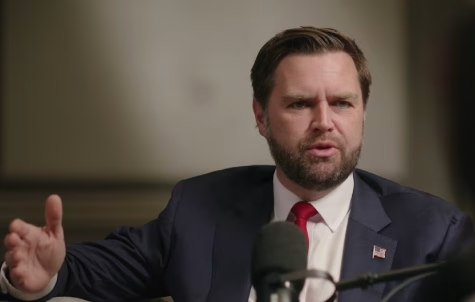
Vice President JD Vance, once a Marine and U.S. Senator from Ohio, has become a central political figure in one of the most consequential foreign policy moments of the 21st century. This U.S. military operation captured Venezuelan President Nicolás Maduro. While the Vice President is not a military commander, his influence on policy, messaging, and regional strategy has made him an essential voice in the emerging conversation about how the United States views its role in the Western Hemisphere, particularly under President Donald Trump’s reimagining of the Monroe Doctrine.
Important resources for this article:
This has been a theme for Vance for some time:
As President Trump discussed on Saturday:
JD Vance’s recent Social Media Post on the issue:
Who Is JD Vance? A Quick Primer
JD Vance, born James David Vance in 1984, is the 50th Vice President of the United States, serving alongside President Donald Trump since January 20, 2025. Before assuming the nation’s second-highest office, Vance was a U.S. Senator from Ohio (2023–2025) and is known for his bestselling 2016 memoir Hillbilly Elegy, which thrust him into national prominence as a voice on working-class America. Vance served in the U.S. Marine Corps and later entered politics, aligning with national conservative and right-wing populist America First factions within the Republican Party.
As Vice President, Vance has been described as potentially one of the most influential modern vice presidents, sometimes compared in stature to figures like former Vice President Dick Cheney due to his close proximity to Trump and his role in shaping policy decisions.
Why Vance Matters in the Maduro Situation
On January 3, 2026, the United States carried out a military operation deep inside Venezuela in which Maduro and his wife, Cilia Flores, were captured and transported to New York to face federal charges. American military forces struck targets in Venezuela and seized Maduro, who U.S. officials have long accused of drug trafficking and narco terrorism.
While Vice President Vance was not physically present at the announcement or spotlighted at the news conference, which led some uninformed people to speculate about Vance’s diminishing importance in the administration, his office confirmed that he was deeply integrated into planning and consulted throughout the process, participating in strategic meetings with Trump and senior officials. Some aides noted that Vance wanted to avoid public visibility during the operation itself to avoid signaling an imminent strike or unnecessarily escalating tensions.
Vance’s Public Defense of the Operation
In a statement shared on X (formerly Twitter), Vance praised the operation and offered insight into the administration’s rationale:
“The president offered multiple off ramps, but was very clear throughout this process: the drug trafficking must stop, and the stolen oil must be returned to the United States. Maduro is the newest person to find out that President Trump means what he says.”
This framing reinforces the White House’s message that the mission was not a reckless act of war but a law enforcement action with geopolitical stakes. Vance also commended the U.S. special operators who executed the operation, underscoring his support for a bold policy posture.
Vance on Drugs, Oil and National Security
Vance has addressed the broader context, including the narcotics discussion, pushing back against narratives that downplay Venezuela’s role in the drug trade. In a recent post, he wrote:
“You see a lot claims that Venezuela has nothing to do with drugs because most of the fentanyl comes from elsewhere. I want to address this:
First off, fentanyl isn’t the only drug in the world and there is still fentanyl coming from Venezuela (or at least there was).
Second, cocaine is a profit center for all of the Latin America cartels. If you cut out the money from cocaine, you substantially weaken the cartels overall. Also, cocaine is bad too.
Third, a lot of fentanyl is coming out of Mexico and is a reason why President Trump shut the border on day one.
Fourth, Venezuela expropriated American oil property and used that to fund their narcoterrorist activities. Are we just supposed to allow a communist to steal our stuff in our hemisphere and do nothing?”
This post underscores why the administration has tied Venezuela not just to drug flows but to broader strategic and economic concerns, including oil, and why Vance believes decisive action was justified.
The Monroe Doctrine Reimagined
The original Monroe Doctrine of 1823 declared that the Western Hemisphere was off limits to European intervention and has since been invoked to justify U.S. strategic hegemony in the hemisphere. Today, Trump and Vance’s policy appears as a 21st-century interpretation of that principle, one focused on combating authoritarian regimes, drug trafficking, economic exploitation, and rival powers’ influence in the region.
On Saturday, in announcing the U.S. military operation that captured Nicolás Maduro, Trump cited the Monroe Doctrine the long-standing U.S. policy that opposes external powers’ influence in the Western Hemisphere. He argued that Venezuela under Maduro had been “hosting foreign adversaries in our region” and acquiring weapons threatening U.S. interests, framing such actions as violating principles going back centuries in American policy.
Why This Matters and Why Vance’s Role Is Significant
The capture of Maduro is a watershed moment in U.S. Latin America relations. It blends criminal justice claims, national security concerns and great power competition, and it raises profound legal and diplomatic questions as countries and international organizations react. Vance’s voice matters because the Vice President:
- Shaped the administration’s narrative of the operation, helping frame it as law enforcement, not imperial conquest.
- Involved himself in planning and policy direction, confirming that vice presidents can meaningfully influence foreign policy even without direct military authority.
- Amplified the strategic rationale linking drugs, regional stability, and U.S. interests in a way that resonates with conservative foreign policy debates.
In other words, Vance embodies how contemporary politics blends domestic priorities with international strategy and how the U.S. conceives its role in the hemisphere under Trump’s leadership.
Bottom Line: JD Vance’s participation in the Maduro saga reflects more than just political support; it illustrates the evolving role of the vice presidency in foreign policy and the way Washington now frames its strategic interests in the Western Hemisphere. Whatever happens next, legally, diplomatically, or militarily, Vance’s imprint on this chapter of American history is real and consequential.
More on our coverage of the Monroe Doctrine: