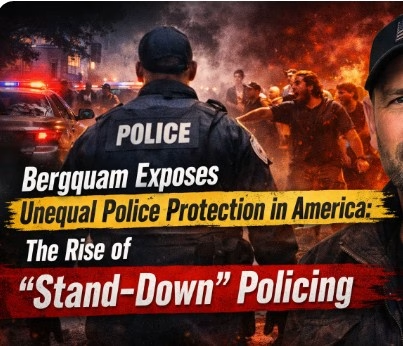
Unequal Protection Is Not Just in the Courts. It’s in the Streets. What Happened in Baltimore and Why It Matters
Video journalist Ben Bergquam has released Part Three of his investigation into what unfolded at a public meeting inside the Enoch Pratt Free Library in Baltimore, Maryland, and then on the public sidewalks outside. What unfolded is a brazen example of the lawlessness many Americans are experiencing as a result of the left’s successful defund the police efforts.
Resources for this article:
Video: https://x.com/BenBergquam/status/2015649346742554867?s=20
Meeting room policy: https://www.prattlibrary.org/services/meeting-rooms
Manual on Defunding the Police: Organized for Change:
According to Bergquam and his colleague, Josh, a public meeting escalated into shouting, physical intimidation, and pushing. They were forced out of the library, then followed into the street, where the confrontation continued. Despite a video showing aggressive conduct by security and participants, police allegedly declined to take a report.
That refusal is the center of the story. Not the argument inside the room. Not the ideology. The refusal to document or intervene when citizens claim they were assaulted in a public place.
Bergquam framed the moment as a snapshot of a much larger shift happening nationwide: a model where police are sidelined while “community organizers” and non-law-enforcement actors increasingly take the place of public safety authority.
A Public Meeting. A Public Street. A Private Standard of Enforcement.
The Baltimore encounter matters because of where it happened.
The Enoch Pratt Free Library makes clear that its meeting rooms are designed for public use. When the meeting ended and the crowd spilled outside, the confrontation moved onto public sidewalks. Those are not private venues. They are not controlled-access spaces. They are the most basic public forum in American life.
Yet the video shows a crowd attempting to drive Bergquam out of a public area, shouting him down, surrounding him, and continuing physical escalation. Bergquam and Josh later said police spoke to some participants but refused to file a report, even though there was video evidence of pushing and physical intimidation.
Whether one agrees or disagrees with Bergquam’s politics is irrelevant. The issue is simple:
Do Americans receive equal protection under the law in public spaces, or does enforcement now depend on who the crowd supports?
When police decline even to document an incident, the message is not neutrality. It is abandonment.
Minneapolis Was Not an Exception. It Was a Prototype.
Bergquam explicitly tied Baltimore to Minneapolis, where viral footage over the last several years has repeatedly shown police ordered to stand down while crowds block roads, surround individuals, or confront journalists.
The Minneapolis experience is not isolated. It reflects what many city governments adopted after 2020:
- reduced proactive policing
- political restrictions on enforcement
- expansion of “community-based” safety models
- reliance on non-police intervention teams
In theory, these programs were sold as de-escalation. In practice, they have often produced uncertain authority, delayed responses, and selective enforcement.
The Baltimore footage fits that pattern. When nobody clearly “owns” public order, the loudest and most aggressive actors frequently fill the vacuum.
The Manuals Didn’t Hide the Plan
This shift did not come out of nowhere.
For more than two decades, progressive activist networks and Democratic-aligned policy groups have published manuals, training documents, and pilot programs focused on replacing or radically constraining traditional policing.
Frontline America has previously documented this transformation:
- “Illegal Aliens Can Become Police and Arrest Americans in Illinois”
https://frontlineamerica.com/transformation-illegal-aliens-can-become-police-and-arrest-americans-in-illinois/ - “DOJ Announces Community Organizers Replace Police in New Drug War, Call Them ‘Cops’”
https://frontlineamerica.com/doj-announces-community-organizers-replace-police-in-new-drug-war-call-them-cops/ - “Irony at the DNC: Chicago Convention Relies on Police Protection That Kamala’s Sister Wants Ended”
https://frontlineamerica.com/irony-at-the-dnc-chicago-convention-relies-on-police-protection-that-kamalas-sister-wants-ended-amidst-antifa-threats/
These documents consistently promote:
- civilian “peace teams”
- activist-aligned intervention groups
- non-law-enforcement authority figures
- the erosion of traditional arrest powers
- political oversight of enforcement decisions
The stated goal is harm reduction. The unstated effect has often been the creation of enforcement-free zones where police hesitate, delay, or refuse involvement altogether.
When Police Stand Down, Power Doesn’t Disappear. It Changes Hands.
One of the most revealing lines from the Baltimore video was not shouted by the crowd. It came afterward.
Josh stated that police spoke with participants but would not even generate a report.
That matters. Police reports are not punishment. They are documentation. They preserve facts. They protect both alleged victims and alleged offenders by creating a neutral record.
When law enforcement declines to document an event, it effectively erases it from the legal system.
That erasure shifts power to whoever controls the space in that moment. Not the law. Not due process. The crowd.
And crowds are not neutral. They have ideologies. They have alliances. They have targets.
Unequal Protection Is the New Normal
For years, Americans have been told that “unequal justice” only exists in courtrooms, charging decisions, and political prosecutions.
Baltimore shows the second half of the transformation.
Unequal protection now happens before any courtroom.
It happens on the sidewalk.
It happens when police decide who is worth protecting.
When officers refuse to intervene or document because a situation is politically sensitive, the law becomes conditional.
And conditional law is not law at all.
The Defund Movement Didn’t Fail. It Succeeded.
Supporters of the “defund the police” movement often insist it was exaggerated or abandoned.
The Baltimore footage suggests otherwise.
The movement’s core objective was never simply budget cuts. It was authority transfer.
From sworn officers to:
- activists
- NGOs
- community organizers
- political appointees
- and civilian “safety” teams
In Baltimore, that transfer is visible. The crowd behaved as though it held enforcement power. Police behavior implied that they agreed.
That is not chaos. That is a new operating system.
Why This Story Should Not Be Ignored
The Baltimore confrontation is not important because of Ben Bergquam.
It is important because it shows what happens when:
- public meetings become ideological zones
- public streets become enforcement gray areas
- police become political referees instead of neutral protectors
A society cannot survive long when protection depends on viewpoint.
That is not reform or equity or community safety.
That is the street-level version of unequal justice.
And it is already here.
Part one of the story: