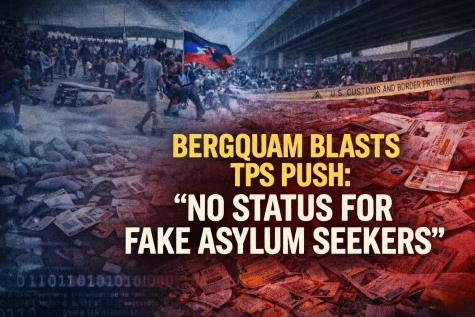
A renewed push in Congress to extend Temporary Protected Status for Haitians is colliding with old footage, disputed asylum narratives, and a fresh round of political messaging about the southern border.
The Video That Keeps Coming Back
Bill Melugin resurfaced video he shot in September 2021 in Del Rio, Texas, showing thousands of Haitian migrants gathered under the international bridge.
“I shot this video… as 15,000+ Haitians flooded across the border illegally,” Melugin wrote, adding that then–DHS Secretary Alejandro Mayorkas “later admitted 12,000+ of them were released into the U.S.”
Melugin also claimed that many migrants “discarded their IDs and paperwork showing they had been living and working in South American countries for years,” saying documents from places like Chile were found on the ground.
That footage and those claims have become a reference point in the current debate.
The Reaction: “No Fake Asylum Seekers”
Ben Bergquam amplified the argument in response, tying the 2021 invasion directly to today’s policy fight.
“No fake asylum seekers should get any protective status,” Bergquam wrote. “Almost all of them came from Chile and Brazil where they had lived comfortably for years.”
He went further, framing the migration surge as politically driven. “They got the invite by the Democrats during Biden’s regime to invade our country.”
The core of his argument mirrors a broader conservative critique: that migrants who transited through or lived in third countries weaken traditional asylum claims based on direct persecution.
The Policy Flashpoint: Haitian TPS Vote
At issue now is whether the House will extend Temporary Protected Status, or TPS, for Haitians already in the United States.
TPS is a legal designation that allows nationals of certain countries facing crisis conditions, such as natural disasters or instability, to remain and work in the U.S. temporarily. Haiti has been a recurring TPS designation due to political instability, economic collapse, and violence.
Supporters of extending TPS argue that conditions in Haiti remain dangerous and justify continued protection.
Critics argue TPS has expanded beyond its original intent and is being used as a long-term workaround for broader immigration policy failures.
What the Broader Reporting Shows
Mainstream reporting from outlets such as Reuters and the Associated Press during the 2021 Del Rio surge confirmed that many Haitian migrants had indeed lived in South American countries before heading north, particularly after earlier migration waves to Brazil and Chile following the 2010 earthquake.
However, those same reports also noted a mix of circumstances:
Some migrants lost jobs during pandemic-era economic downturns in South America
Others faced discrimination or lacked legal status in those countries
Many cited deteriorating conditions in Haiti as a long-term concern
U.S. immigration law does not automatically disqualify asylum claims based on transit through third countries, though it can factor into determinations depending on policy and enforcement posture.
Where the Fight Is Headed
The current vote is not just about Haiti. It is about how the U.S. defines eligibility, credibility, and limits in its immigration system.
Melugin’s footage and Bergquam’s reaction represent one side of the argument, emphasizing fraud risk and system abuse.
Supporters of TPS extension point to humanitarian conditions and legal protections already embedded in U.S. policy.
What is clear is that the debate is no longer abstract. It is anchored in images, documents, and competing interpretations of the same problem.
And with a House vote on the table, those interpretations are about to turn into policy.