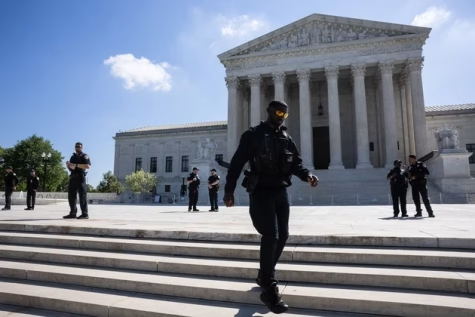
The U.S. Supreme Court has issued a narrow 5–4 decision that could significantly expand executive power over immigration enforcement, granting Donald Trump the ability to invoke the Alien Enemies Act to deport suspected members of Tren de Aragua without going through standard immigration court proceedings.
The ruling signals the Court is willing to treat cartel and gang-linked migration as a national security issue, potentially allowing deportations under wartime legal authorities rather than traditional immigration law.
Jessie Waters talked about it on Tuesday:
According to the decision, the majority found that the President has broad discretion under the Alien Enemies Act when the United States faces what can be interpreted as a foreign threat. Historically, that law has only been used during declared wars, including World War I and World War II. The Court’s interpretation appears to extend its reach into modern transnational criminal activity, particularly when linked to organized groups operating across borders.
At the center of the case is the administration’s argument that Tren de Aragua functions as more than a criminal gang. Government filings reportedly framed the organization as a quasi-paramilitary network operating across Latin America and into the United States, exploiting migration routes to establish footholds in multiple cities. That framing was key to justifying use of a wartime statute rather than relying on existing immigration enforcement tools.
The ruling allows for expedited removal of individuals designated under the Act, with deportations reportedly directed toward detention facilities in El Salvador, including its high-profile mega-prison system. That raises immediate legal and humanitarian questions about due process, evidentiary standards, and conditions of confinement once individuals are transferred خارج U.S. jurisdiction.
The dissenting justices warned that the decision risks collapsing the line between wartime authority and domestic law enforcement. They argued that the Alien Enemies Act was never intended to apply outside formally declared wars and that expanding its use could allow any administration to bypass immigration courts by labeling groups as foreign threats.
Legal analysts are now watching how broadly the executive branch applies the ruling. A narrow application focused on clearly identified criminal actors would likely face less resistance. A broader interpretation that sweeps in migrants based on loose associations could trigger immediate constitutional challenges, particularly around habeas corpus and Fifth Amendment protections.
This also puts Congress back in the spotlight. Lawmakers have debated for years how to handle cartel-linked migration and transnational gangs, but the Court’s decision effectively gives the executive branch a new tool that sidesteps legislative gridlock. Whether Congress moves to clarify or restrict the use of the Alien Enemies Act will be a key next step.
For now, the decision marks a shift in how national security, immigration, and criminal enforcement intersect. It reframes parts of the border debate away from civil immigration violations and toward a wartime posture against organized networks. How far that shift goes will depend on how aggressively the ruling is used and how quickly it is challenged in lower courts.